# Middleware
Source: https://docs.nestjs.com/middleware
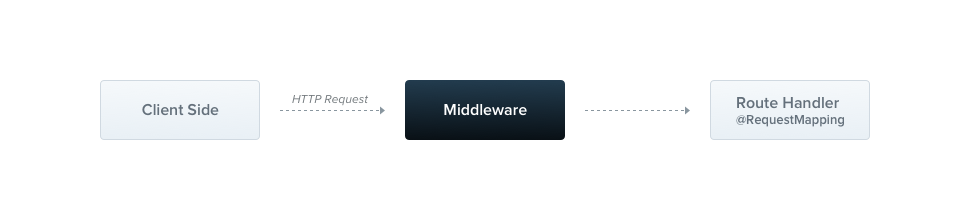
Middleware is a function that is called **before** the route handler. Middleware functions have access to the [request](https://expressjs.com/en/4x/api.html#req) and [response](https://expressjs.com/en/4x/api.html#res) objects, and to the `next()` middleware function in the application's request-response cycle. The **next** middleware function is commonly denoted by a variable named `next`.
By default, Nest middleware is equivalent to [Express](https://expressjs.com/en/guide/using-middleware.html) middleware. The official Express documentation describes the capabilities of middleware as follows:
Middleware functions can perform the following tasks:
execute any code.
make changes to the request and the response objects.
end the request-response cycle.
call the next middleware function in the stack.
if the current middleware function does not end the request-response cycle, it must call next() to
pass control to the next middleware function. Otherwise, the request will be left hanging.
You implement custom Nest middleware either as a function or as a class with the `@Injectable()` decorator. A class should implement the `NestMiddleware` interface, while a function has no special requirements. Let's start by implementing a simple middleware class.
> warning **Warning** Express and Fastify handle middleware differently and provide different method signatures, while the Node adapter uses the Express signature. See the [HTTP adapters](/http/performance#middleware) chapter for details.
```typescript
import { Injectable, NestMiddleware } from '@nestjs/common';
import type { Request, Response, NextFunction } from 'express';
@Injectable()
export class LoggerMiddleware implements NestMiddleware {
use(req: Request, res: Response, next: NextFunction) {
console.log('Request...');
next();
}
}
```
#### Dependency injection
Nest middleware fully supports dependency injection. Like providers and controllers, middleware classes can **inject dependencies** that are available within the same module. As usual, dependencies are injected through the `constructor`.
#### Applying middleware
Middleware is not registered in the `@Module()` decorator. Instead, you set it up in the `configure()` method of the module class. Modules that include middleware must implement the `NestModule` interface. Let's set up the `LoggerMiddleware` at the `AppModule` level.
```typescript
import { Module, NestModule, MiddlewareConsumer } from '@nestjs/common';
import { LoggerMiddleware } from './common/middleware/logger.middleware.js';
import { CatsModule } from './cats/cats.module.js';
@Module({
imports: [CatsModule],
})
export class AppModule implements NestModule {
configure(consumer: MiddlewareConsumer) {
consumer
.apply(LoggerMiddleware)
.forRoutes('cats');
}
}
```
In the example above, the `LoggerMiddleware` is applied to the `/cats` route handlers defined in the `CatsController`. To restrict middleware to a particular request method, pass an object containing the route `path` and the request `method` to the `forRoutes()` method. The example below imports the `RequestMethod` enum to reference the desired request method.
```typescript
import { Module, NestModule, RequestMethod, MiddlewareConsumer } from '@nestjs/common';
import { LoggerMiddleware } from './common/middleware/logger.middleware.js';
import { CatsModule } from './cats/cats.module.js';
@Module({
imports: [CatsModule],
})
export class AppModule implements NestModule {
configure(consumer: MiddlewareConsumer) {
consumer
.apply(LoggerMiddleware)
.forRoutes({ path: 'cats', method: RequestMethod.GET });
}
}
```
> info **Hint** The `configure()` method can be asynchronous. Declare it with `async` to `await` the completion of an asynchronous operation inside the method body.
> warning **Warning** With the Express adapter, Nest registers the `json` and `urlencoded` body parsers (`express.json()` and `express.urlencoded()`) by default. To customize these parsers through the `MiddlewareConsumer`, disable the defaults by setting the `bodyParser` option to `false` when creating the application with `NestFactory.create()`.
#### Route wildcards
Middleware also supports pattern-based routes. For example, the named wildcard (`*splat`) matches any combination of characters in a route. In the following example, the middleware runs for any route that starts with `abcd/`, regardless of how many characters follow.
```typescript
forRoutes({
path: 'abcd/*splat',
method: RequestMethod.ALL,
});
```
> info **Hint** `splat` is only the name of the wildcard parameter and has no special meaning. You can use any name, e.g., `*wildcard`.
The `'abcd/*splat'` route path matches `abcd/1`, `abcd/123`, `abcd/abc`, and so on. String-based paths interpret the hyphen (`-`) and the dot (`.`) literally. However, `abcd/` with no additional characters does not match. To match it as well, wrap the wildcard in braces to make it optional:
```typescript
forRoutes({
path: 'abcd/{*splat}',
method: RequestMethod.ALL,
});
```
> warning **Warning** A plain string path matches subpaths differently across adapters. With Express and the Node adapter, `forRoutes('cats')` also runs the middleware for subpaths like `/cats/breed`. With Fastify, it matches only `/cats`. To match `/cats` and its subpaths on every adapter, put the slash inside the optional wildcard: `forRoutes('cats{/*splat}')`.
#### Middleware consumer
The `MiddlewareConsumer` is a helper class that provides several built-in methods to manage middleware. All of them can be **chained** in the [fluent style](https://en.wikipedia.org/wiki/Fluent_interface). The `forRoutes()` method accepts a single string, multiple strings, a `RouteInfo` object, a controller class, or multiple controller classes. In most cases, you'll pass a comma-separated list of **controllers**. Below is an example with a single controller:
```typescript
import { Module, NestModule, MiddlewareConsumer } from '@nestjs/common';
import { LoggerMiddleware } from './common/middleware/logger.middleware.js';
import { CatsModule } from './cats/cats.module.js';
import { CatsController } from './cats/cats.controller.js';
@Module({
imports: [CatsModule],
})
export class AppModule implements NestModule {
configure(consumer: MiddlewareConsumer) {
consumer
.apply(LoggerMiddleware)
.forRoutes(CatsController);
}
}
```
> info **Hint** The `apply()` method accepts either a single middleware or multiple arguments to specify multiple middleware.
#### Excluding routes
To **exclude** certain routes from having middleware applied, use the `exclude()` method. It accepts a single string, multiple strings, or a `RouteInfo` object that identifies the routes to exclude:
```typescript
consumer
.apply(LoggerMiddleware)
.exclude(
{ path: 'cats', method: RequestMethod.GET },
{ path: 'cats', method: RequestMethod.POST },
'cats/{*splat}',
)
.forRoutes(CatsController);
```
With the example above, `LoggerMiddleware` is bound to all routes defined inside `CatsController` **except** those matching the three entries passed to the `exclude()` method.
> info **Hint** The `exclude()` method supports wildcard parameters using the [path-to-regexp](https://github.com/pillarjs/path-to-regexp#parameters) package.
Paths passed to `exclude()` are declared without the [global prefix](/faq/global-prefix), which Nest adds unless the route is excluded from it. If an exclusion matches a path that is excluded from the global prefix and has no parameters or wildcards, the middleware is also skipped for that path, which is served without the prefix. This match follows the case sensitivity of the router.
```typescript
// main.ts
app.setGlobalPrefix('api', { exclude: ['health', 'health/ready'] });
// app.module.ts
consumer
.apply(LoggerMiddleware)
.exclude('health', 'health/*splat')
.forRoutes('*splat');
```
Here, `health/*splat` also skips the middleware for `/health/ready`. It doesn't match `/health` itself, so `health` is listed as well.
#### Functional middleware
The `LoggerMiddleware` class we've been using is minimal: it has no members, no additional methods, and no dependencies. Middleware like this can be defined as a plain function instead of a class. This type of middleware is called **functional middleware**. Let's convert the logger middleware from a class into a function to illustrate the difference:
```typescript
import type { Request, Response, NextFunction } from 'express';
export function logger(req: Request, res: Response, next: NextFunction) {
console.log('Request...');
next();
}
```
Then use it within the `AppModule`:
```typescript
consumer
.apply(logger)
.forRoutes(CatsController);
```
> info **Hint** Consider using **functional middleware** whenever your middleware doesn't need any dependencies.
#### Multiple middleware
To bind multiple middleware that execute sequentially, pass a comma-separated list to the `apply()` method:
```typescript
consumer.apply(cors(), helmet(), logger).forRoutes(CatsController);
```
#### Global middleware
To bind middleware to every registered route at once, use the `use()` method of the `INestApplication` instance:
```typescript
const app = await NestFactory.create(AppModule);
app.use(logger);
await app.listen(process.env.PORT ?? 3000);
```
> info **Hint** Global middleware registered with `app.use()` cannot access the DI container, so use [functional middleware](middleware#functional-middleware) there. Alternatively, use a class middleware and bind it with `.forRoutes('*')` within the `AppModule` (or any other module).
#### Error handling
When middleware throws an exception, Nest's [exceptions layer](/exception-filters) catches it and sends an appropriate response, just as it does for exceptions thrown from a route handler. The recommended approach is to throw an `HttpException` (or a built-in subclass such as `UnauthorizedException`):
```typescript
import {
Injectable,
NestMiddleware,
UnauthorizedException,
} from '@nestjs/common';
import type { Request, Response, NextFunction } from 'express';
@Injectable()
export class AuthMiddleware implements NestMiddleware {
use(req: Request, res: Response, next: NextFunction) {
if (!req.headers.authorization) {
throw new UnauthorizedException();
}
next();
}
}
```
If the middleware is asynchronous, declare `use()` as `async` (or return a `Promise`) so that a rejected promise is forwarded to the exceptions layer:
```typescript
@Injectable()
export class AuthMiddleware implements NestMiddleware {
constructor(private readonly authService: AuthService) {}
async use(req: Request, res: Response, next: NextFunction) {
const user = await this.authService.verify(req.headers.authorization);
if (!user) {
throw new UnauthorizedException();
}
req['user'] = user;
next();
}
}
```
You can also pass the error to `next()`. This is useful when wrapping existing Express-style middleware that reports failures through the callback:
```typescript
use(req: Request, res: Response, next: NextFunction) {
if (!req.headers.authorization) {
return next(new UnauthorizedException());
}
next();
}
```
> warning **Warning** Because middleware runs before a route handler is selected, only **global** exception filters (registered with `app.useGlobalFilters()` or the `APP_FILTER` token) catch exceptions thrown from middleware. Method-scoped and controller-scoped filters are not invoked, and binding filters to a middleware class with `@UseFilters()` is not supported.
> info **Hint** Middleware registered with `app.use()` is handled by the underlying HTTP platform (Express or Fastify), not by Nest's `MiddlewareModule`. Prefer throwing errors (or calling `next(err)`) from middleware bound with the `MiddlewareConsumer`, so that the exceptions layer can process them.