
Interceptors
An interceptor is a class annotated with the @Injectable() decorator. The interceptor should implement the NestInterceptor interface.
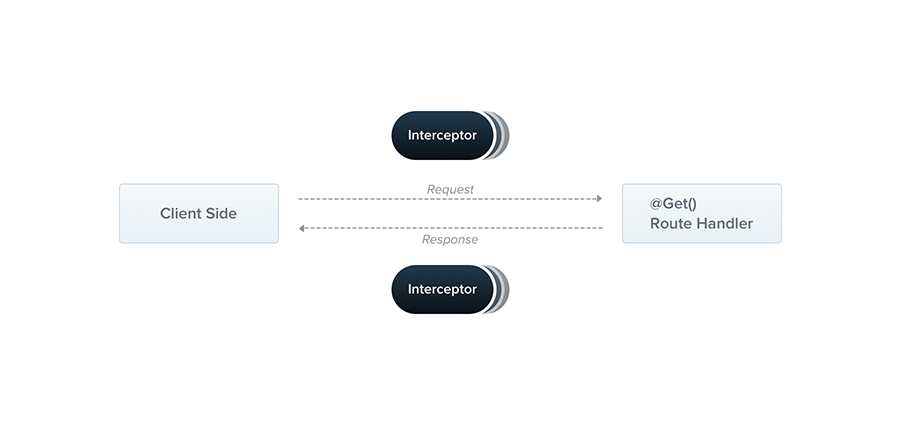
Interceptors have a set of useful capabilities which are inspired by the Aspect-Oriented Programming (AOP) technique. They make possible to:
- bind extra logic before / after method execution
- transform the result returned from a function
- transform the exception thrown from a function
- extend the basic function behaviour
- completely override a function depending on the chosen conditions (e.g. caching purposes)
Basics
Each interceptor has the intercept() method that takes 2 arguments. The first one is the ExecutionContext instance (exactly the same object as for guards). The ExecutionContext inherits from ArgumentsHost (first mention here). The ArgumentsHost is a wrapper around arguments that have been passed to the original handler, and it contains different arguments array under the hood based on the type of the application.
export interface ArgumentsHost {
  getArgs<T extends Array<any> = any[]>(): T;
  getArgByIndex<T = any>(index: number): T;
  switchToRpc(): RpcArgumentsHost;
  switchToHttp(): HttpArgumentsHost;
  switchToWs(): WsArgumentsHost;
}
The ArgumentsHost supplies us with a set of useful methods that helps to pick correct arguments from the underlying array. In other words, ArgumentsHost is nothing else than just an array of arguments. For example, when the guard is used within HTTP application context, ArgumentsHost will contain [request, response] array inside. However, when current context is a web sockets application, this array will be equal to [client, data]. This design decision enables you to access any argument that would be eventually passed to the corresponding handler.
The ExecutionContext offers a little bit more. It extends ArgumentsHost, but also, provides more details about current execution process.
export interface ExecutionContext extends ArgumentsHost {
  getClass<T = any>(): Type<T>;
  getHandler(): Function;
}
The getHandler() returns a reference to the currently processed handler, while getClass() returns a type of the Controller class which this particular handler belongs to. Using other words, if the user points to create() method that is defined and registered within CatsController, the getHandler() will return a reference to the create() method and getClass() in this case, will simply return a CatsControllertype (not instance).
The second argument is a call$, an Observable stream. If you don't return this stream, the main handler won't be evaluated at all. What does it mean? Basically, the call$ is a stream that defers the final handler execution. Let's say, someone made a POST /cats request. This request points to create() handler defined inside the CatsController. If an interceptor which does not return a call$ stream is called along the way, the create() method won't be evaluated. Only when call$ stream is returned, the final method will be triggered. Why? Because Nest subscribes to the returned stream and uses values that this stream produces to create either a single response or multiple responses for the end-user. Moreover, as mentioned a while ago, call$ is an Observable, meaning, it supplies us with a set of very powerful operators that helps with, for example, response manipulation.
Aspect interception
The first use case is to use the interceptor to add extra logic either before or after the function execution. It's useful when we're gonna log interaction with the application, e.g. storing user calls, asynchronously dispatching events or calculating the timestamp. As an example, let's create a simple LoggingInterceptor.
import { Injectable, NestInterceptor, ExecutionContext } from '@nestjs/common';
import { Observable } from 'rxjs';
import { tap } from 'rxjs/operators';

@Injectable()
export class LoggingInterceptor implements NestInterceptor {
  intercept(
    context: ExecutionContext,
    call$: Observable<any>,
  ): Observable<any> {
    console.log('Before...');

    const now = Date.now();
    return call$.pipe(
      tap(() => console.log(`After... ${Date.now() - now}ms`)),
    );
  }
}
import { Injectable } from '@nestjs/common';
import { Observable } from 'rxjs';
import { tap } from 'rxjs/operators';

@Injectable()
export class LoggingInterceptor {
  intercept(context, call$) {
    console.log('Before...');

    const now = Date.now();
    return call$.pipe(
      tap(() => console.log(`After... ${Date.now() - now}ms`)),
    );
  }
}
Hint TheNestInterceptor<T, R>is a generic interface in whichTindicates a type of the processedObservable<T>(behind the stream), whileRthe return type of the value wrapped into returnedObservable<R>.
Notice Interceptors act the same as controllers, providers, guards, and so on, meaning, they can inject dependencies through the constructor. Since call$ is a RxJSObservable, we have a lot of various operators which we can use to manipulate the stream. In the example above, We used the tap() operator that invokes the function upon graceful or exceptional termination of the observable sequence.
In order to set up the interceptor, we use the @UseInterceptors() decorator imported from the @nestjs/common package. Same as guards, interceptors can be controller-scoped, method-scoped, and global-scoped as well.
@UseInterceptors(LoggingInterceptor)
export class CatsController {}
Hint The@UseInterceptors()decorator is imported from the@nestjs/commonpackage.
Thanks to that, each route handler defined in CatsController will use LoggingInterceptor. When someone calls the GET /cats endpoint, you'll see a following output in your console window:
Before...
After... 1ms
Note that we passed the LoggingInterceptor type instead of an instance, leaving framework the instantiation responsibility and enabling dependency injection. Another available way is to pass the immediately created instance:
@UseInterceptors(new LoggingInterceptor())
export class CatsController {}
As mentioned before, the construction above attaches the interceptor to every handler declared by this controller. If we decide to restrict only one of them, we just need to set up the interceptor at method level. In order to bind the global interceptor, we use the useGlobalInterceptors() method of the Nest application instance:
const app = await NestFactory.create(ApplicationModule);
app.useGlobalInterceptors(new LoggingInterceptor());
The global interceptors are used across the whole application, for every controller and every route handler. In terms of dependency injection, global interceptors registered from the outside of any module (as in the previous example above) cannot inject dependencies since they don't belong to any module. In order to solve this issue, you can set up a guard directly from any module using following construction:
app.module.ts
import { Module } from '@nestjs/common';
import { APP_INTERCEPTOR } from '@nestjs/core';

@Module({
  providers: [
    {
      provide: APP_INTERCEPTOR,
      useClass: LoggingInterceptor,
    },
  ],
})
export class ApplicationModule {}
Hint The alternative option is to use an execution context feature. Also, useClass is not the only way of dealing with custom providers registration. Learn more here. Response mapping
We already know that call$ is an Observable. This object contains the value returned from the route handler, and thus we can easily mutate it using the map() operator.
Warning The response mapping feature doesn't work with the library-specific response strategy (using the @Res() object directly is forbidden). Let's create the TransformInterceptor that will take each response and modify it by assigning to the data property of the newly created object.
import { Injectable, NestInterceptor, ExecutionContext } from '@nestjs/common';
import { Observable } from 'rxjs';
import { map } from 'rxjs/operators';

export interface Response<T> {
  data: T;
}

@Injectable()
export class TransformInterceptor<T>
  implements NestInterceptor<T, Response<T>> {
  intercept(
    context: ExecutionContext,
    call$: Observable<T>,
  ): Observable<Response<T>> {
    return call$.pipe(map(data => ({ data })));
  }
}
import { Injectable } from '@nestjs/common';
import { map } from 'rxjs/operators';

@Injectable()
export class TransformInterceptor {
  intercept(context, call$) {
    return call$.pipe(map(data => ({ data })));
  }
}
Hint Nest interceptors work like a charm with asynchronousintercept()methods, meaning, you can effortlessly switch your method toasyncif necessary.
Afterward, when someone calls the GET /cats endpoint, the request would look like below (we assumed that route handler returns an empty array []):
{
    "data": []
}
The interceptors have a huge potential when it comes to creating reusable solutions used in whole applications. For example, let's imagine that we need to transform each occurred null value to empty string ''. We can do it using one line of code and bind interceptor as a global one. Thanks to that, it'll be automatically reused by each registered handler.
import { Injectable, NestInterceptor, ExecutionContext } from '@nestjs/common';
import { Observable } from 'rxjs';
import { map } from 'rxjs/operators';

@Injectable()
export class ExcludeNullInterceptor implements NestInterceptor {
  intercept(
    context: ExecutionContext,
    call$: Observable<any>,
  ): Observable<any> {
    return call$.pipe(map(value => value === null ? '' : value ));
  }
}
import { Injectable } from '@nestjs/common';
import { map } from 'rxjs/operators';

@Injectable()
export class ExcludeNullInterceptor {
  intercept(context, call$) {
    return call$.pipe(map(value => value === null ? '' : value ));
  }
}
Exception mapping
Another interesting use-case is to take advantage of the catchError() operator to override thrown exceptions:
import {
  Injectable,
  NestInterceptor,
  ExecutionContext,
  HttpStatus,
} from '@nestjs/common';
import { HttpException } from '@nestjs/common';
import { Observable, throwError } from 'rxjs';
import { catchError } from 'rxjs/operators';

@Injectable()
export class ErrorsInterceptor implements NestInterceptor {
  intercept(
    context: ExecutionContext,
    call$: Observable<any>,
  ): Observable<any> {
    return call$.pipe(
      catchError(err =>
        throwError(new HttpException('Message', HttpStatus.BAD_GATEWAY)),
      ),
    );
  }
}
import { Injectable, HttpStatus } from '@nestjs/common';
import { HttpException } from '@nestjs/common';
import { throwError } from 'rxjs';
import { catchError } from 'rxjs/operators';

@Injectable()
export class ErrorsInterceptor {
  intercept(context, call$) {
    return call$.pipe(
      catchError(err =>
        throwError(new HttpException('Message', HttpStatus.BAD_GATEWAY)),
      ),
    );
  }
}
Stream overriding
There're several reasons why sometimes we might want to completely prevent calling the handler and return a different value instead (e.g. from cache due to performance issues). An excellent example is a cache interceptor that would store the cached responses with some TTL. Unfortunately, this feature needs a bit more code and due to simplification, we'll provide only a basic example that should briefly explain the main concept.
cache.interceptor.ts
import { Injectable, NestInterceptor, ExecutionContext } from '@nestjs/common';
import { Observable } from 'rxjs';
import { of } from 'rxjs/observable/of';

@Injectable()
export class CacheInterceptor implements NestInterceptor {
  intercept(
    context: ExecutionContext,
    call$: Observable<any>,
  ): Observable<any> {
    const isCached = true;
    if (isCached) {
      return of([]);
    }
    return call$;
  }
}
import { Injectable } from '@nestjs/common';
import { of } from 'rxjs/observable/of';

@Injectable()
export class CacheInterceptor {
  intercept(context, call$) {
    const isCached = true;
    if (isCached) {
      return of([]);
    }
    return call$;
  }
}
Here's a CacheInterceptor with a hardcoded isCached variable and the hardcoded response [] as well. We returned a new stream here, created through the of operator, therefore the route handler won't be called at all. When someone calls endpoint that makes use of CacheInterceptor, the response (a hardcoded, empty array) will be returned immedietely. In order to create a generic solution, you can take advantage of Reflector and create a custom decorator. The Reflector is well described in the guards chapter.
The possibility of returning the stream gives us many possibilities. Let's think about another common use-case. Imagine you would like to handle timeouts. When your endpoint doesn't return anything after a period of time, we want to respond with an error response.
timeout.interceptor.ts
import { Injectable, NestInterceptor, ExecutionContext } from '@nestjs/common';
import { Observable } from 'rxjs';
import { timeout } from 'rxjs/operators';

@Injectable()
export class TimeoutInterceptor implements NestInterceptor {
  intercept(
    context: ExecutionContext,
    call$: Observable<any>,
  ): Observable<any> {
    return call$.pipe(timeout(5000))
  }
}
import { Injectable } from '@nestjs/common';
import { timeout } from 'rxjs/operators';

@Injectable()
export class TimeoutInterceptor {
  intercept(context, call$) {
    return call$.pipe(timeout(5000))
  }
}
After 5 seconds the request processing will be canceled.